

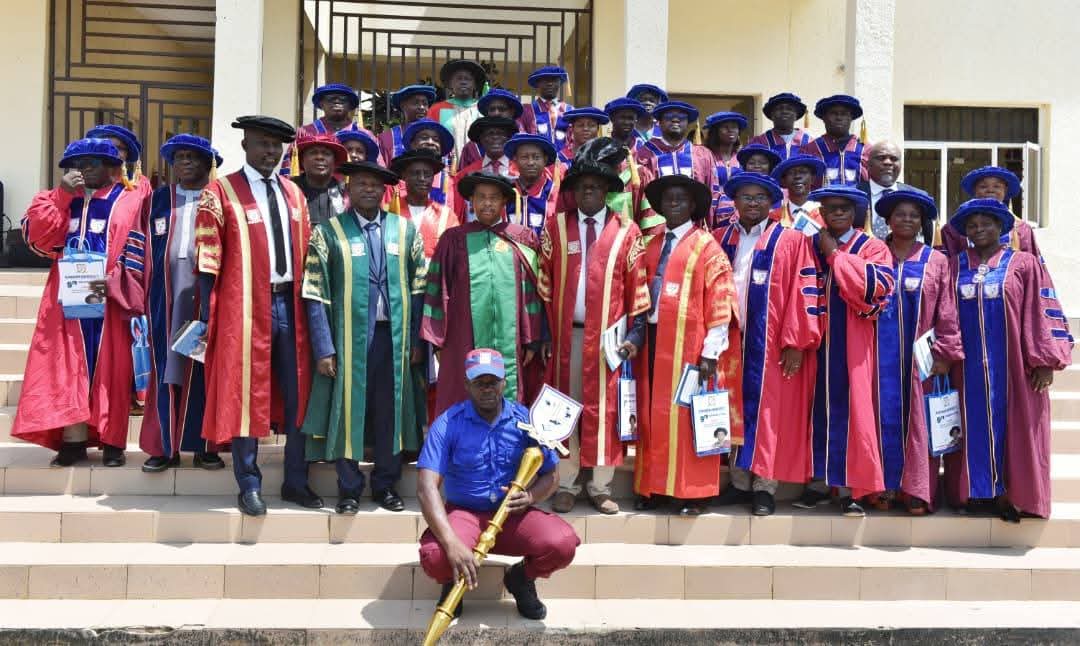
Bingham University Holds 9Th Inaugural Lecture Delivered By Prof. Michael S. Akpan Titled “Being An Economist: The Homo Economicus”
Published on: Oct 30th, 2025
Bingham University, Karu, was aglow with intellectual excitement as scholars, students, and dignitaries gathered for the institution’s 9th Inaugural Lecture, delivered by Prof. Michael S. Akpan, the immediate past Dean of the Faculty of Social Sciences.
The lecture, titled “Being an Economist: The Homo Economicus,” explored one of the most enduring debates in economic thought—the relevance and resilience of the so-called “economic man” in today’s world.
Declaring the event open, the Vice-Chancellor, Prof. Haruna Kuje Ayuba, described the day as a celebration of intellectual depth and academic excellence. He commended Professor Akpan’s scholarly contributions and hailed the lecture as both timely and deeply reflective of Nigeria’s current economic realities.
According to him, the University’s Inaugural Lecture Series remains a cornerstone of its academic culture—serving as a platform for showcasing research that challenges conventional thinking and inspires innovative solutions.
“At Bingham University, we remain committed to nurturing a generation of thinkers who question, explore, and design solutions that address our local realities,” he said.
Prof. Ayuba also used the occasion to advocate for home-grown economic strategies, emphasizing that Nigeria’s economic challenges demand indigenous solutions rooted in the nation’s unique social and cultural contexts.
“Beyond theories, economists must help bridge the gap between policy and practice in tackling poverty, inflation, unemployment, and other pressing national concerns,” he noted.
He urged scholars to move beyond imported models and engage in research that reflects Nigeria’s lived experiences.
“Today’s lecture should not only enlighten us but also provoke conversations that lead to practical, home-grown interventions,” he added.
Delivering his lecture, Prof. Michael S. Akpan traced the origins of Homo Economicus—the “economic man”—to the writings of classical economists such as Adam Smith. He described the model as representing a rational individual who makes decisions to maximize benefits and minimize costs.
“For centuries, this concept has shaped modern economics,” Akpan explained. “The economic man is rational, self-interested, and efficient, but he is also often misunderstood. He was not designed to describe all human behavior but to model how individuals act within markets as producers, buyers, and consumers.”
He acknowledged the criticisms that have trailed the model, particularly from behavioral and feminist economists, who argue that it neglects emotion, morality, and social influence.
“Scholars like Thaler and Sunstein have reminded us that human beings are not purely rational calculators,” Akpan observed. “Even feminist economists have asked, quite pointedly, why there was no ‘economic woman’ in early economic theories.”
In a spirited defense, the Inaugural Lecturer maintained that Homo Economicus remains relevant—not as a perfect reflection of human behavior, but as a valuable guide for understanding decision-making in an increasingly complex economy.
“In today’s world, the economic man has evolved,” he said. “He now operates in imperfect markets shaped by technology, innovation, and global interdependence. He is not just a profit maximizer but also a problem solver, innovator, and strategist.”
Drawing from both historical and contemporary examples, Prof. Akpan argued that the same principles of rationality and efficiency that guided early industrialists continue to underpin modern governance, business, and policymaking.
“Despite criticisms, the economic man continues to breathe,” he said with a smile. “He is alive and active—adapting to new realities while remaining central to the logic that drives economies forward.”
He further challenged Nigerian economists to reinterpret classical theories in ways that reflect African realities.
“Our task,” he emphasized, “is not to discard economic models, but to reshape them to fit our environment, our values, and our people.”
The event concluded with a vote of thanks delivered by the Registrar, Mr. Daburi Bello Misal, who expressed gratitude to God for the successful outing, to the Vice-Chancellor for his leadership, and to the organizing committee for their dedication. He also appreciated the guests for their attendance, describing their presence as “a vital ingredient that adds colour and meaning to such academic celebrations.”
The detailed lecture booklet delivered by Prof. Michael S. Akpan was presented to the Vice -Chancellor, Prof. Haruna Kuje Ayub. Thereafter, a plaque was presented to the distinguished Prof. Michael S. Akpan in recognition of his academic contribution, followed by a group photograph to commemorate the occasion.
...........................................................................
Directorate of Public Affairs
Office of the Vice-Chancellor
Bingham University