

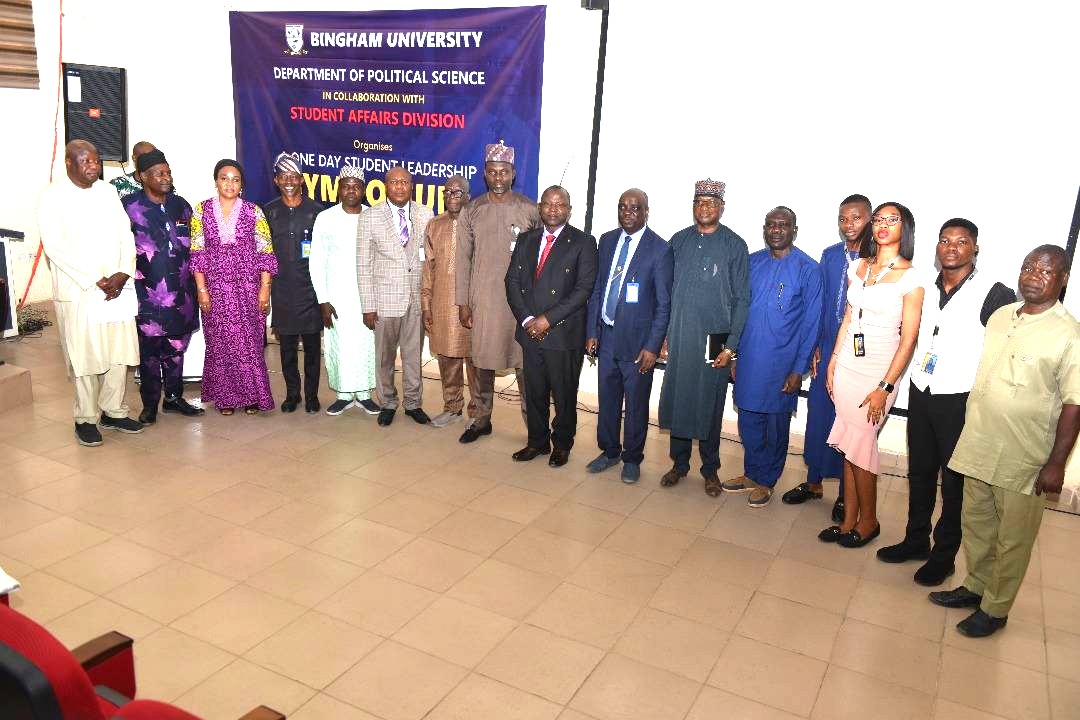
Bingham University Hosts Landmark Symposium On Empowering Student Leaders
Published on: Jan 27th, 2026
Bingham recently hosted a landmark symposium themed “Empowering University Student Leaders for Effective Governance,” reaffirming its commitment to grooming responsible, innovative, and value-driven student leaders.
The symposium, which was jointly organized by the Department of Political Science and the Student Affairs Division, brought together university management, faculty members, student leaders, and invited guest speakers to deliberate on leadership, governance, and innovation in the university system.
In his opening remarks, the Vice-Chancellor, Professor Haruna Kuje Ayuba, emphasized the strategic importance of empowering student leaders as partners in university governance. He highlighted the historic election of the university’s first female SRC President, Miss Oluwaseyi Precious Onyeyirichukwu Chidume, describing it as a reflection of Bingham University’s inclusive leadership culture.
Professor Ayuba commended the SRC leadership for impactful initiatives such as the “Keep It Clean and Green” campaign and its collaboration with the Centre for Innovation, Entrepreneurship, and Leadership Studies (CIELS). He noted that platforms such as the SRC, Bingham University Student Fellowship (BHUSF), clubs, and associations are deliberate investments in students’ future leadership capacity.
The Vice-Chancellor urged student leaders to take ownership of their roles by effectively managing resources, leading teams responsibly, and serving as vital links between university management and the student body. He outlined key expectations of student leaders to include disseminating information on university policies, gathering feedback, driving positive change, promoting democratic values, and fostering responsible citizenship.
Delivering the keynote address, the Deputy Vice-Chancellor, Professor Musa Dankyau, spoke on “Faith-Rooted Leadership for Effective Governance.” He presented a leadership framework built on five pillars to include character, competence, communication, collaboration, and continuity, defining leadership as “the capacity and will to rally people to a common purpose.” According to him, faith-rooted leadership emphasizes servant-oriented, relational processes that influence others toward purposeful and values-driven goals.
The Dean of Student Affairs, Associate Professor Ogwuche David, made a presentation on “Innovative Leadership Initiatives at Bingham University.” He underscored the importance of democratic, inclusive, transparent, and ethical leadership in student governance, while highlighting technology-driven, participatory, and design-thinking approaches as critical to modern leadership. He also identified challenges such as limited experience, funding constraints, resistance to change, and poor communication, recommending stronger institutional support and investment in innovation infrastructure.
Also speaking at the symposium, Ambassador Bulus Lolo delivered a thought-provoking presentation on “Students’ Rights, Responsibilities, Diversities, Equity, Inclusion and Leadership.” He described leadership as Nigeria’s greatest challenge and stressed that the enjoyment of rights must be balanced with responsibility. He called on students to embrace diversity, equity, and inclusion, eschew parochialism, cultivate accountability, and resist insularity and narrow-mindedness.
The symposium further explored the role of technology in leadership development by Dr. Eunice E. Ortom and Mr. Michael Agbo John from their paper presentation titled, “The Role of Technology in Mentorship and Support for Student Leaders,” highlighting how digital platforms like AI-driven tools, and virtual mentorship systems can enhance accessibility, personalized guidance, and measurable leadership growth.
The one-day symposium marked the launch of an annual student leadership empowerment programme, with future focus areas expected to include stewardship, mentorship, and financial management. The symposium provided a robust platform for equipping student leaders with essential skills in communication, decision-making, conflict resolution, and ethical governance, reinforcing Bingham University’s vision of producing leaders who are competent, innovative, and value-driven.
In his closing remark, Prof. Zabadi Istifanus, Director of Research and Innovation, commended the organizers of the programme, saying it's a step in the right direction. He expressed optimism that Bingham University graduates will undoubtedly excel in their future careers and leadership roles.
.....................................................
Directorate of Public Affairs
Office of the Vice-Chancellor
Bingham University